Jun 24, 2013

The G8 should push for a ceasefire in Syria, Pope tells David Cameron | CatholicHerald.co.uk

The G8 should push for a ceasefire in Syria, Pope tells David Cameron | CatholicHerald.co.uk
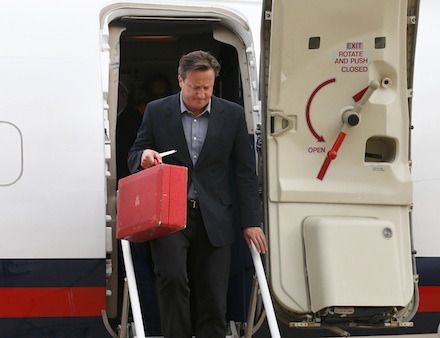
David Cameron arrives in Belfast ahead of the G8 summit (PA)

David Cameron arrives in Belfast ahead of the G8 summit (PA)

The G8 nations meeting in Northern Ireland this week should push for “an immediate and lasting ceasefire” in Syria, Pope Francis has said in a letter to the British Prime Minister.

Responding to an earlier letter from David Cameron, Pope Francis wrote: “I earnestly hope that the summit will help to obtain an immediate and lasting ceasefire and to bring all parties in the conflict to the negotiating table. Peace demands a far-sighted renunciation of certain claims, in order to build together a more equitable and just peace. Moreover, peace is an essential pre-requisite for the protection of women, children and other innocent victims, and for making a start towards conquering hunger, especially among the victims of war.”

In his letter the Pope noted that the summit, which takes place today and tomorrow at Lough Erne in County Fermanagh, would focus on the British Government’s priorities of “the free and international market, taxation, and transparency on the part of the governments and economic actors”.

But he said that “fundamental reference to man is by no means lacking” in the summit agenda.

“The goal of economics and politics is to serve humanity, beginning with the poorest and most vulnerable wherever they may be, even in their mothers’ wombs,” he said. “This is the main thing; in the absence of such a vision, all economic activity is meaningless.”

Full text of Pope Francis’s letter to David Cameron, dated June 15:

To The Right Honourable David Cameron, MP Prime Minister,

I am pleased to reply to your kind letter of 5 June 2013, with which you were good enough to inform me of your Government’s agenda for the British G8 Presidency during the year 2013 and of the forthcoming Summit, due to take place at Lough Erne on 17 and 18 June 2013, entitled A G8 meeting that goes back to first principles.

If this topic is to attain its broadest and deepest resonance, it is necessary to ensure that all political and economic activity, whether national or international, makes reference to man. Indeed, such activity must, on the one hand, enable the maximum expression of freedom and creativity, both individual and collective, while on the other hand it must promote and guarantee their responsible exercise in solidarity, with particular attention to the poorest.

The priorities that the British Presidency has set out for the Lough Erne Summit are concerned above all with the free international market, taxation, and transparency on the part of governments and economic actors. Yet the fundamental reference to man is by no means lacking, specifically in the proposal for concerted action by the Group to eliminate definitively the scourge of hunger and to ensure food security. Similarly, a further sign of attention to the human person is the inclusion as one of the central themes on the agenda of the protection of women and children from sexual violence in conflict situations, even though it must be remembered that the indispensable context for the development of all the afore-mentioned political actions is that of international peace.

Sadly, concern over serious international crises is a recurring theme in the deliberations of the G8, and this year it cannot fail to address the situation in the Middle East, especially in Syria. In this regard, I earnestly hope that the Summit will help to obtain an immediate and lasting ceasefire and to bring all parties in the conflict to the negotiating table. Peace demands a far-sighted renunciation of certain claims, in order to build together a more equitable and just peace. Moreover, peace is an essential pre-requisite for the protection of women, children and other innocent victims, and for making a start towards conquering hunger, especially among the victims of war.

The actions included on the agenda of the British G8 Presidency, which point towards law as the golden thread of development – as well as the consequent commitments to deal with tax avoidance and to ensure transparency and responsibility on the part of governments – are measures that indicate the deep ethical roots of these problems, since, as my predecessor Benedict XVI made clear, the present global crisis shows that ethics is not something external to the economy, but is an integral and unavoidable element of economic thought and action. The long-term measures that are designed to ensure an adequate legal framework for all economic actions, as well as the associated urgent measures to resolve the global economic crisis, must be guided by the ethics of truth. This includes, first and foremost, respect for the truth of man, who is not simply an additional economic factor, or a disposable good, but is equipped with a nature and a dignity that cannot be reduced to simple economic calculus. Therefore concern for the fundamental material and spiritual welfare of every human person is the starting-point for every political and economic solution and the ultimate measure of its effectiveness and its ethical validity.

Moreover, the goal of economics and politics is to serve humanity, beginning with the poorest and most vulnerable wherever they may be, even in their mothers’ wombs. Every economic and political theory or action must set about providing each inhabitant of the planet with the minimum wherewithal to live in dignity and freedom, with the possibility of supporting a family, educating children, praising God and developing one’s own human potential. This is the main thing; in the absence of such a vision, all economic activity is meaningless.In this sense, the various grave economic and political challenges facing today’s world require a courageous change of attitude that will restore to the end (the human person) and to the means (economics and politics) their proper place. Money and other political and economic means must serve, not rule, bearing in mind that, in a seemingly paradoxical way, free and disinterested solidarity is the key to the smooth functioning of the global economy.

I wished to share these thoughts with you, Prime Minister,, with a view to highlighting what is implicit in all political choices, but can sometimes be forgotten: the primary importance of putting humanity, every single man and woman, at the centre of all political and economic activity, both nationally and internationally, because man is the truest and deepest resource for politics and economics, as well as their ultimate end.Dear Prime Minister, trusting that these thoughts have made a helpful spiritual contribution to your deliberations, I express my sincere hope for a fruitful outcome to your work and I invoke abundant blessings upon the Lough Erne Summit and upon all the participants, as well as upon the activities of the British G8 Presidency during the year 2013, and I take this opportunity to reiterate my good wishes and to express my sentiments of esteem.

Full text of David Cameron’s letter to Pope Francis, dated June 5:

Your Holiness,

When I said farewell to Pope Benedict at the end of his historic State Visit to Britain in September 2010, I made a number of promises. I said that the United Kingdom would keep its promises on aid, in particular in dedicating 0.7% of GNI to international development aid, despite the tough economic times. I said that we would continue to help the poorest and ensure the money we spend on aid goes to those who need it most. I also promised that we would redouble our resolve to work for the common good, working closely with the Holy See.In 2013, the United Kingdom holds the Presidency of the G8 group of nations.

I am determined to ensure that our G8 agenda will lead to real benefits for the global economy and will help people in developed and developing countries alike. Your Holiness has spoken eloquently about the need to rebalance the global economy, to help the poor and disadvantaged, and to find people work. My aim for our G8 Presidency, especially at the G8 Summit at Lough Erne on 17 and 18 June, is to do this by restoring strong and sustainable growth to the world economy by practical action on fairer taxes, freer trade, and greater transparency.

I will use the G8 to galvanise collective international action to effectively tackle tax evasion and aggressive tax avoidance – problems shared by developed and developing countries alike. We shall promote a new global standard for automatic information exchange between tax authorities to shrink the space for tax evasion. We shall provide political support for the ongoing OECD and G20 work to prevent some individuals and corporates artificially shifting their profits to ultra-low tax jurisdictions, distorting competition and seek to enhance the flow of information to tax authorities. We shall seek to set out concrete steps we will take to let law enforcement and tax collectors find out who really owns and controls every company. We shall also explore what more can be done by the G8 to support lower-income developing countries to collect the tax revenues owed to them, thereby strengthening their public services in areas like health and education on which people’s well-being depends.

On trade, I know the Vatican has taken a keen interest in trade liberalisation, particularly the potential that it offers to alleviate poverty, and the need to ensure the poorest countries are integrated into the global economy. This is very much in line with the trade agenda for Lough Eme. We shall ensure that the G8 shows leadership on free trade by opening our markets, resisting protectionism and supporting an open, global rule-based trading system to ensure that all countries can benefit from increased trade. Protectionism and trade bureaucracy are amongst the most significant brakes on the global economy, affecting developing and developed economies alike and creating a barrier to economic and social progress. This is why I will put political impetus on progressing bilateral and plurilateral deals as well as supporting the multilateral trading system.

We will support efforts to conclude a multilateral deal on Trade Facilitation at the WTO Ministerial Conference in December, which could add $70 billion to the global economy and would help boost trade in Africa in particular. We will also work with African countries to help them realise their goal of a Continental Free Trade Area, including through our support for regional integration. This could see intra-African trade double by 2022. If G8 countries complete all of their current trade deals and those in the pipeline, it could boost the income of the whole world by more than $1 trillion.

Under our G8 Presidency, I also want to see real progress on tackling food and nutrition insecurity through practical action and greater political commitment to fighting global malnutrition.Many of the world’s poorest countries are shackled by a lack of transparency, poor mles, corrupt practices and weak capacity. Too often, a veil of secrecy allows corrupt corporations and officials in countries to flout the law and prevent development. Too often, mineral wealth in developing countries becomes a curse rather than a blessing, as a lack of transparency fosters crime and corruption. Too often, instead of a shared hope for the next generation, such wealth brings conflict, greed, and environmental damage. Through the G8, I plan to push for mandatory higher global standards for the extractives sector, to encourage responsible and sustainable investment in land, and setting the standards for ensuring that government data are released in an open and useable format.

Finally, the High Level Panel Report on the post-2015 development agenda, which we transferred to the UN Secretary General last week, highlighted the importance of trade, tax and transparency to better the lives of the world’s poorest. The Report presents an ambitious roadmap to eradicate extreme poverty from the face of the earth by 2030. It says that everyone – regardless of gender, ethnicity, income, disability, age – must have their basic needs met, and their economic and human rights respected. It too makes a strong call for economic growth that promotes social inclusion and preserves the planet’s natural resources for future generations. It says that freedom from violence, good governance and justice are not only fundamental to achieving poverty eradication, but goods in themselves that all citizens of the world have equal right to enjoy. I hope that you will be able to read the Report and offer support for its core messages.You have called for disinterested solidarity and for a return to person-centred ethics in the world of finance and economics. As President of the G8, I aim to help secure the growth and stability on which the prosperity and welfare of the whole world depends. To do this, we must tackle the conditions that cause poverty, stiffen the sinews of responsible capitalism, and strengthen governance and transparency.

I believe that this path is one which requires more than the G8 to find success, that responsible governments, business and faiths can and should travel together, doing what we can to turn these values into practical action for the benefit of all.

Apr 23, 2013

Boston Bombing Suspects' uncle tells of familial break

Boston Bombing Suspects' uncle tells of familial break - YouTube

After Boston and Tsarnaevs, Russians Urge U.S. to Rethink Chechnya - NYTimes.com

Pedestrians cross Putin Prospect, one of the main streets in the Chechen capital Grozny on April 20.
Reuters Pedestrians cross Putin Prospect, one of the main streets in the 
Chechen capital Grozny on April 20.
After Boston and Tsarnaevs, Russians Urge U.S. to Rethink Chechnya - NYTimes.com
LONDON — Russian commentators are speculating that a Chechen connection in the Boston Marathon bombings will force the United States to reassess its view of the Kremlin’s actions in the troubled Caucasus region.
After the capture on Friday night of Dzhokhar A. Tsarnaev, the second suspect in Monday’s attack, following the death of Tamerlan Tsarnaev, his brother, in a gun battle with police, U.S. authorities have yet to establish a motive for the crime.
In Russia, as in the United States, attention focused on whether the bombings were connected with the politics of Chechnya, where the brothers’ family originated.
Reuters Pedestrians cross Putin Prospect, one of the main streets in the Chechen capital Grozny on April 20.
The possibility of such a connection being established is already raising questions about what it means for the recently strained relationship between Moscow and Washington.

Brother’s Keeper: Did Older Sibling Lure Bombing Suspect Into Plot? | TIME.com

Brother’s Keeper: Did Older Sibling Lure Bombing Suspect Into Plot? | TIME.com

Brother’s Keeper: Did Older Sibling Lure Bombing Suspect Into Plot?


The dramatic arrest of Boston Marathon bombing suspect Dzhokhar Tsarnaev on Friday night brought the entire city of Boston a collective sense of relief, with crowds streaming into the streets to chants of USA. But the end of the manhunt was in many ways just the start of the process for investigators trying to piece together what may have motivated Tsarnaev, 19, and his older brother Tamerlan, 26, who was killed by police early Friday morning. And details emerging over the first 24 hours since police captured the younger Tsarnaev in a backyard boat in Watertown, Mass., reinforce the growing perception that his older brother was the primary driver of the attack.

Mar 10, 2013

Beppe Grillo leads yet another right-wing cult from Ita

Austerity and its discontents

A group blog On Europe edited by Daniel Trilling
Syndicate contentRSS

Essay: beneath its populist surface, the Five Star Movement represents more of the same.


Beppe Grillo, at a pre-election rally in Rome on 22 February. (Photo: Getty.)
Marriage is a bond between a man and a woman. How can you institute marriage between two persons of the same sex? Why not marriage between three persons then? Why not marriage between you and your animal? Some people have a strong relationship with their animal, would you allow them to marry it?
(Francesco Perra, 5 Star Movement candidate at the recent national election, 8 June 2012 )
There is much confusion in other countries about what has been taking place in Italy in the past five years – the era of Late Berlusconism – and what is going on after the latest national election. At the time of writing, nobody knows what government Italy will have. No stable government can be formed without the vote of confidence of the Five Star Movement, the political organisation led by former stand-up comedian Beppe Grillo and web marketing guru Gianroberto Casaleggio. The Five Star Movement (5SM), which stood for national election for the first time, gained 25.5 per cent of votes for the Chamber of Deputies and 23.8 per cent for the Senate.

Nov 25, 2012

LUKOIL opens new terminal at Barcelona port

LUKOIL opens new terminal at Barcelona port // Companies // News | Neftegaz.RU
02 May 2012 , 10:31Neftegaz.RU672
Vagit Alekperov, President of OAO LUKOIL, and Jose Luis Porté, President of Meroil, participated in the festive ceremony today dedicated to the commissioning of a new petroleum terminal at the port of Barcelona (Spain).

The project was implemented by a joint venture (50/50) established in July, 2010 between LITASCO, an international oil trader (a wholly-owned subsidiary of LUKOIL), and the Spanish company Meroil.
The new terminal was constructed as part of a project to expand Meroil’s existing terminal capacities.


Thirteen new tanks with an aggregate storage capacity of 360,000 cubic meters, and ranging in volume from 6,500 to 40,000 cubic meters, were constructed within an area of 40,000 square meters. The new terminal, connected to the pipeline system of Hydrocarbonates Logistics Company, includes 8 petroleum-product loading gantries with at hroughput capacity of 400 tank trucks per day.

Sep 10, 2012

From the European ‘Party of Discontents’ to the Authoritarian ‘Axis of Resistance' to the West?

By Irina Severin | 20.08.12

Will Merkel's Visit to Moldova Make a Difference?


Why Angela Merkel, the most influential European politician, in the midst of the EU financial crisis decided to visit Moldova - Europe's poorest and otherwise insignificant country? Why bother?

A glance at the map shows that Moldova including its breakaway region Transnistria (self-proclaimed in 1990-s with the Russian Army support) is sandwiched between two countries, problematic for the EU:  Ukraine with the "Tymoshenko case" and Romania with the 'Basescu case'. Both countries Romania as a member of the EU and Ukraine,   proclaiming the European aspirations demonstrate clear potential for sliding into authoritarianism. 

In both cases, there are indications of Russian involvement in domestic political processes. In the Romanian case, Russia was traced as encouraging the Ponta-Antonescu 'coup' against Basescu. In Ukraine, Russia's growing meddling limits Ukrainian potential for democratization.

The economic pressure is another instrument of influence. In both cases,  gas prices being political are used for control of the political and economic situation in the countries.

Transnistria, existing mostly for justification of the Russian military presence in the region, is a direct threat to security in the Europe, not a "stabilizing factor" as Russia pretends.  Russia involvement wouldn't be a threat if Moscow were moving to rapprochement with the EU modernizing its political and economic system. Germany is interested in cooperation with Russia, but both the EU and Germany need to see that Russia is open for the European values as a precondition for closer interaction and for being guaranty for stability.
In 2009 Angela Merkel offered closer cooperation to Medvedev in exchange to Russia constructive role in the Transnistrian frozen conflict settlement. Russia didn't advance in this direction preferring to impose its will maintaining its military presence on the border with the EU. Russia is quite pessimistic about the EU future considering it a temporary experiment and recalling that about 50 years ago European countries were each other’s worst enemy.
Moscow thinks that the EU dissolution would rise Russia to a great power status. Though, Russia's plans are much more ambitious. Russia considers its  Eurasian Union an alternative to the EU and doesn't limit it with the former USSR borders as some used to think. 

As Fyodor Lukyanov mentions in his article Uncertain World: Does Europe Have Any Alternative? Moscow doesn't exclude that it can relapse in what it names 'big Balkan game’ and even ‘big Orthodox game’ (including Greece and Serbia, for instance)."
From the European 'Party of Discontents'…
Meantime Russia tries to get control over the EU's decision-making without abiding by the European principles, but converting the EU countries to its own political 'matrix'. Technically this is achievable by encouraging the EU countries' politicians to break the EU political standards and oppose to the EU requirements. 

Now this is happening in Romania with Ponta government.  He came to power by organizing protests against President Basescu accusing him in complying with the tight the EU and IMF requirements.  Ponta's actions are tempered for now by coming parliamentary elections. Romanians are staunchly pro-European, and any anti-European rhetoric would obstruct their chances to win elections. 

Earlier Greek Syriza incited long-term protests against the EU and IMF, what put on the brink of collapse not only Greece but the EU and Eurozone as well. 

Opposing to the EU and the IMF from left or right by default puts any country into the Russian sphere of influence and at Russia's mercy.  Lukyanov names this opposition to the EU "the growing "party of discontents": "Both ideological extremes are brought together by the new rhetoric calling on the government to defend the public against the social ills of globalization". Further, he explains:
The difference between the ‘party of recovery’(consisting of Conservatives, Christian Democrats, Liberals and Social Democrats) versus the 'party of discontents' lies in their ability to run the state. The former has a clear idea of what should be done and how, but finds it increasingly difficult to garner public support, while its opponent can channel public sentiment but lacks a strategy of its own. The discontents are chanting slogans without assuming any responsibility. 
Ideological developments are more complicated. One EU country, Hungary, is already essentially turning its back on European valuesIt is increasingly leaning towards a more conservative and nationalist policy. 
On another side of Moldova - in Ukraine Russia recently managed to considerably advance its interests in exchange for a promise of lower gas prices. The "Language law" offers status of the regional language to the Russian language making the Ukrainian language redundant in more than half of Ukraine. 

Now Russian propagandists promote as the next step the idea of partition of Ukraine on the Ukrainian-speaking West and predominantly Russian-speaking rest of the country, where the Ukrainian language will be excluded, and the Ukrainian speakers will become the unprotected minority. 


The "Language law" has radicalized and polarized political situation in Ukraine,  making the country unstable before the elections. Not to mention here the incarceration of the opposition leaders, what is the anathema for the EU, but an apparent gain for Russia.
On this background,  Moldova despite all odds following democratic principles and adopting European values is looking like a rare case of success, which can become a showcase for others. The country doesn't require massive investments and is genuinely European. 
At the same time, lack of 'clear European prospective' for Moldova makes it a subject of the Russian pressure. One of the instruments is artificially created fringe movements: pro-Russian, invoking reunification with Russia and 'anti-Russian', promoting reunification with Romania. 

Both extremes exploit and boost nationalistic moods and raise the grade of polarization of the society. Recent March, organized by a fringe group supporting Unification with Romania, led to staged clashes with the "Patriots of Moldova", another fringe group, promoting the idea of unification with Russia. Naturally, such performances don't encourage the Transnistrian conflict resolution. Quite the opposite - they offer a justification for the existence of Russia's  military outpost on the Dniester. 
…To the Authoritarian 'Axis of Resistance' to the West
Merkel's encouragement of Moldova's European aspirations can strengthen Moldova as a stability factor in the region as well as a positive example for the neighboring countries. Otherwise, Moldova as small as it is can trigger a massive destabilization,  which can reach as far as the Balkans and Greece. Moldova’s territorial integrity and sovereignty is a key for the European security and stability.
If not supported now Moldova together with the EU's "party of discontents" one day can become a part of the authoritarian 'Axis of resistance' to the West, which Putin is working hard to create after his return to the presidency. 

The Authoritarian Axis became apparent due to the Syria case. Apparently, it includes Russia, Syria, China, Iran, North Korea, Venezuela. The situation starts to resemble the "Cold War" bi-polar world order when two sides were fighting for promoting their political models to expand their influence. 

Putin managed to replace the communism with the ideology of the Resistance to the West but has nothing to offer as an alternative political or economic model. Exactly as the European  "party of discontent", ‘ "detected"  by Lukyanov,  Moscow knows how to "channel public sentiment" and "to sow the seeds of discontent’ around the world, but doesn't know what to do next. Being underdeveloped and ineffective Russia could only lead the world to the chaos. 
For many years the reply of the West to Russia's growing assertion abroad was 'we don't fight with Russia'. But the problem is that Russia is fighting the West. And the West should at least acknowledge this. And if not fighting back at least to secure democratic values and principles in the world with some meaningful steps. Supporting Moldova today Merkel invests in stability and security in the Europe, what can be not achievable tomorrow.
The next day after Angela Merkel's announcement about her coming to Moldova Prime Minister Vlad Filat has got an invitation from  Moscow to meet Vladimir Putin after Merkel's visit. Will Moldova become the next target of promises of lower gas prices in exchange for the anti-Western  'discontent moves'?

Jun 15, 2012

Is Ron Paul A Useful Idiot?

Is Ron Paul A Useful Idiot?
Big Peace ^

Posted on Sunday, August 28, 2011 07:38:01 AM by mnehring
You saw it here first, folks!
Clueless?
Over at the American Spectator, the great Jeffrey Lord writes that “almost to a person … prominent pre-Ron Paul non-interventionist “Paulist” politicians of the 20th century were overwhelmingly not conservatives at all. They were men of the left. The far left.”
From three-time Democratic presidential nominee and Woodrow Wilson Secretary of State William Jennings Bryan to powerful Montana Democratic Senator Burton K. Wheeler to FDR’s ex-vice presidential nominee Henry Wallace to the 1968 anti-war presidential candidacy of Minnesota Democratic Senator Eugene McCarthy to 1972 Democratic presidential nominee (and Henry Wallace delegate in 1948) George McGovern, non-interventionists have held prominent positions in the American Left that was and is the Democratic Party.(emphasis added)

What was unique about Wallace’s 1948 Progressive Party campaign was how it was completely controlled by the secret Communist Party agents that surrounded Wallace, despite the fact that he was not a Communist. Lillian Hellman, who despite her denials was indeed a secret member of the Communist Party, admitted as much in her 1976 book Scoundrel Time:
During the early autumn of 1948, four or five of us [leaders of the Progressive Party campaign] were eating lunch together on the day of a large evening rally. When lunch was finished Wallace suggested that he and I take a walk. … When we had walked for a while, he asked me if it was true that many of the people, the important people, in the Progressive Party were Communists. It was such a surprising question that I laughed and said most certainly it was true.
He said, “Then it is true, what they’re saying?”
“Yes,” I said. “I thought you must have known that. The hard, dirty work in the office is done by them and a good deal of the bad advice you’re getting is given by the higher-ups. I don’t think they mean any harm; they’re stubborn men.”
“I see,” he said, and that was that.
What is clear is that the Communists – who, of course, did mean harm – were able to drive the campaign of a non-Communist due to their influence. And Wallace knew it, despite his public denials. As Arthur Herman pointed out in National Review “when Hubert Humphrey complained about the prominent role Communists were playing in the election, Wallace blithely told him to go talk to the Russian embassy — it had more influence over his campaign officials than he did.”

So if it can happen to Henry Wallace, why can’t it happen to his Republican mirror, Ron Paul? On Thursday, Mark Levin had Jeffrey Lord on his show to talk about his article (listen to it here, here and here), where they discussed all the crackpots and “neo-confederates” that surround Ron Paul in his inner circle. What would a group like think of, say, Israel?

Well, on his own website, we find that: “On January 9, [2009] Ron Paul addressed Congress to voice his opposition to a House resolution expressing strong support for Israel in its invasion of Gaza, and branding Hamas as a terrorist organization.” It goes on to proudly highlight that he went on Press TV (the Iranian state propaganda channel) and Russia Today (KGB-TV basically, with it’s paid agents promoting and even doing fund-raising for Ron Paul).
Anyone who has spent time around his supporters know what they think of Israel, and likely had to hear the anti-Semitic conspiracy theories that are so widespread in his little cult. What is their influence? Why doesn’t he denounce them? Also, such a denunciation would have a devastating impact both the national and international crackpot communities that sustain anti-Americanism, as the great Cold War era defector and former KGB General turned American Patriot Ion Mihai Pacepa explained. Wouldn’t that be in our national interest, Dr. Paul?

Jun 8, 2012

Russia eXaminer: Russia and China - Partnership of "Rabbit and Boa"

Russia eXaminer

Russia-China Anti-Western Friendship Leads to Global Chaos and Russia Takeover

By Irina Severin | 07.06.2012
Putin's three-day visit to China after his demonstrative refusal to participate in the Summit of the developed countries in the United States says that he does have something to discuss with the Chinese leadership. Moreover this is an opportunity to demonstrate to the West that Putin has an alternative. There is no doubt that he feels more comfortable there where nobody recalls of human rights and democracy, what Putin calls unnecessary "ideologization" in relations with the West.

May 26, 2012

Fight for Ukraine is not over

By Irina Severin | 05.25.2012
Merkel seeks Tymoshenko's  treatment In Germany. Tymoshenko's safety in Ukraine can not be guaranteed despite the extra security measures employed

Moderate expectations

A shift in the EU relation to Ukraine from threatening with boycott  to cooperation hopefully will give its fruits. Azarov's invitation for the EU lawyers to take part in Tymoshenko trial gives possibility to resolve the problem with Tymoshenko imprisonment without creating an impression that Yanukovych gave up to the pressure, but he does this in the context of approximation of the Ukrainian judiciary system  to the EU standards. 
The problem for the EU is that Yanukovych never gives up to the pressure - be it from Moscow or from Brussels. An opposite - if the pressure is applied he will act against his own interests and the interests of the country protecting first of all his self-esteem. Even if black and white approach is understandable at the parliamentary level, as politicians care more about the impression they create and reelection and not always are able to get to the the essence of the problem, at the executive and diplomatic level should be employed more sophisticated approach.
It seems that a search for the mutual acceptable solution was exactly the reason of the Ukrainian  prime-minister invitation for the European lawyers to take part in the Tymoshenko trial as well as the proposition that they can study all related to the case documents in order to evaluate them from the European point of view.  

May 19, 2012

Radical left and neo-Nazis score well in Greek elections

EUobserver.com / Political Affairs / Radical left and neo-Nazis score well in Greek elections

Radical left and neo-Nazis score well in Greek elections

06.05.12 @ 21:46
By Valentina Pop
 
BRUSSELS - Greek voters on Sunday (6 May) punished the two ruling parties responsible for the last EU bail-out and its austerity measures by giving the radical left the second highest number of votes and allowing a neo-Nazi party into the legislature for the first time.
Early official results after 10 percent of the votes were count show that the centre-right New Democracy party has gained the most votes (19.2%) but it is not enough to re-make the current ruling coalition with the Social Democrats (Pasok).

Apr 13, 2012

Signs of Gasoline Price Drop May Thwart Case Against Obama

Bloomberg News By Jim Snyder on April 10, 2012 Companies Mentioned

  • OIL
    iPath Goldman Sachs Crude Oil Total Return Index ETN
    • $25.82 USD
    • -0.21
    • -0.81%
Signs that gasoline prices may have peaked signal relief to both American drivers and President Barack Obama, who Republicans have tried to tie to a climb in the costs.
Average prices at the pump have hovered at $3.92 a gallon this month, after an almost uninterrupted rise since mid- January. Some analysts now believe they’ll start to recede, as oil fell to an eight-week trading low on forecasts U.S. supplies would rise to their highest level for this time of year.
That may be good news for Obama, because gasoline costs had risen to among the top concerns for Americans and voters tend to blame incumbents for their economic anxieties, says Bruce Oppenheimer, a Vanderbilt University professor who has studied energy and politics.

Mar 29, 2012

Guess Romney won't be getting the Pravda endorsement

Posted By Joshua Keating     Share
The once proud Communist Party propaganda arm-turned-supermarket tabloid/LOL-aggregator unloads on the GOP frontrunner:
Electing Mitt Romney as the next President of the United States of America would be like appointing a serial paedophile as a kindergarten teacher, a rapist as a janitor at a girls' dormitory or a psychopath with a fixation on knives as a kitchen hand. His comments on Russia are a puerile attempt at making the grand stage and boy, did he blow it...
Romney's "number one geopolitical foe" remark seems to be bringing out the best in Russian official bombast:
...Public Chamber Foreign Affairs working group head Alexander Sokolov [compared] him to one of the “Marlboro men, those so-called cool guys, for whom only America’s interests exist and all other countries are potential enemies – or at best, rivals.”
Even the normally staid Dmitry Medvedev said Romney's remark "smacks of Hollywood" and advised him to "check his watch": “It’s 2012, not the middle of the 1970s,”  
Romney reiterated his attacks on the president's open-mic incident in a piece for FP yesterday, in which he said, "It is not an accident that Mr. Medvedev is now busy attacking me. The Russians clearly prefer to do business with the current incumbent of the White House."
Obama's foreign-policy advisors responded here.  

Mar 21, 2012

Uncertain World: Russia - U.S. - Back to Business? | Columnists | RIA Novosti

Uncertain World: Russia - U.S. - Back to Business? | Columnists | RIA Novosti

Columnists

Uncertain World: Russia - U.S. - Back to Business?

19:44 15/03/2012
Weekly column by Fyodor Lukyanov
Tags: New START Treaty, presidential elections 2012, World Trade Organization (WTO), John McCain, Hillary Clinton, Vladimir Putin, Barack Obama, United States, Russia
The latest intrigue in Russian-U.S. relations was U.S. President Barack Obama’s delayed official greetings to president-elect Vladimir Putin on his win. The U.S. Department of State made a low-key announcement about the presidential election in Russia, which did not even refer to the winner by name. Secretary of State Hillary Clinton urged the Russian government to heed criticisms voiced by the OSCE. Republican presidential hopeful Mitt Romney reproached Obama for his failure to criticize the “flagrant manipulation.” Finally, long-time Russia critic Sen. John McCain again predicted the liberation of the Russian people from tyranny in the manner of the Arab Spring. An official spokesman for the White House said that there was nothing personal in Obama’s delay – the head of state was simply very busy.

© RIA Novosti.
Finally, on March 9, Obama called Putin and a detailed conversation followed. Moscow had stated earlier that the positive trends in bilateral relations of the last few years will be continued. There was no scandal and Putin’s victory was accepted, albeit without much enthusiasm. The sides have differences but will try not to highlight them for the time being. Moreover, there was an indirect signal this week that they will even try to minimize the fallout from the negative tone of the election campaigns in both countries.
The newspaper Kommersant quotes sources as saying that the relocation of the G8 summit in May from Chicago to Camp David is linked with Obama’s reluctance to create a negative atmosphere in relations with Russia. The G8 forum will be followed by a NATO summit in Chicago and Putin promised to attend it only in the event that progress is made on missile defense. Progress is not on the horizon, and Putin’s demonstrative departure from Chicago would only create unnecessary chatter about the collapse of the reset. This is not to say that his presence at the NATO summit would improve the atmosphere. The president-elect would likely only perpetuate the cycle of mutual accusations that has become routine since 2000. The Americans are not confirming anything on the record. Off the record, they describe Putin as one of the reasons, but not the main one. However, both Moscow and Washington clearly understand the fragility of the moment and the need for tact.
Putin’s guarded and mistrustful attitude to the United States is common knowledge, and he makes no attempt to conceal it. The reasons for it lie not in his record during the Cold War, as many often claim, but in his experience in dealing with the George W. Bush administration during its first and, particularly, second term.
Whether fair or not, Putin has come to the conclusion that a gentlemen’s agreement is not possible with the United States. He thinks Bush responded with base ingratitude to Moscow’s positive gestures more than once – from its support during 9/11 and the subsequent war on terror, to its voluntary closing of military facilities in Vietnam and Cuba. Putin  believes that these gestures were met with aggressive efforts of the United States to bolster its presence in the post-Soviet space, expand NATO, and deploy missile defense systems on Polish and Czech territory, to name a few. As a result, Putin has come to the conclusion that agreements with the United States are possible but only following tough and uncompromising bargaining, as was the case with the New START treaty and Russia’s accession to the WTO.
However, the bigger problem is that the new governments (and meaningful talks are not possible earlier than next spring when the presidential election is over in the United States as well) do not have a clear-cut positive agenda. They have carried through the reset. Now they are facing the same old issues: Afghanistan and Iran. The former is simpler: the organized withdrawal of U.S. troops and maintaining relative stability there is in the interests of all parties. This should not create any special problems. The situation around Iran strongly depends on numerous external factors. Moscow and Washington will discuss both issues, but they can hardly form the basis of a new bilateral agenda.
The first obstacle the new leaders will face will be the same old story of missile defense. Putin dealt with this issue during his previous presidency, when he made proposals to Bush. He does not intend to give up now. A compromise is hardly possible because missile defense is a matter of principle for both sides. Russia insists that the United States plan is a threat to its security whereas the United States is confident of its right to move forward regardless of any country’s response. The potential for conflict is obviously strong. Moscow acknowledges that as long as the principle of strategic stability – Mutual Assured Destruction (MAD) – remains, missile defense talks will be stuck in an impasse. But there does not appear to be any other principle that would suit both sides.
There is nothing else to discuss. There will be no opportunity to maintain dialogue by negotiating nuclear arms cuts again. First, Russia believes further reductions would diminish its defensive capabilities. After all, Moscow has to consider other factors as well, such as China, which is gradually building up its military strength. Second, even if Russia and the United States decide to resume talks on this issue, this is not a full-scale agenda of the 21st century. For the time being the sides are surviving on table scraps from the 20th century, but they are almost all gone.
*
Is Russia unpredictable? Perhaps, but one shouldn’t exaggerate – its randomness often follows a consistent pattern. But is the world at large predictable? The past two decades have seen all forecasts refuted more than once and have taught us only one thing – to be ready for any change. This column is on what the nations and governments are facing in the era of global uncertainty.
Fyodor Lukyanov is Editor-in-Chief of the Russia in Global Affairs journal – the most authoritative source of expertise on Russian foreign policy and global developments. He is also a frequent commentator on international affairs and contributes to various media in the United States, Europe and China, including academic journals Social Research, Europe-Asia Studies, Columbia Journal of International Affairs. Mr. Lukyanov is a senior member of the Council on Foreign and Defense Policy and a member of the Presidential Council on Human Rights and Civic Society Institutions. He holds a degree from Moscow State University.
Uncertain World: Why I Sympathize With Vladimir Putin
Uncertain World: Vladimir Putin in a World of Risks and Danger
Uncertain World: Why Does Russia’s Stance on Syria Baffle Everyone?
Uncertain World: Medvedev’s Foreign Policy: Period of Stabilization
Uncertain World: Anti-Americanism in Russia
Uncertain World: Will Russia Lose Georgia for Good?
Uncertain World: What Russia thinks of Syria
Uncertain World: The war of nerves around Iran
Uncertain World: The Arab Spring in global context