Aug 11, 2014

Маргарита Симоньян: Общественное мнение важнее, чем ядерное оружие

4 марта 2010, 13:28 0

В программе "Мировая политика" - главный редактор телеканала "Russia Today"Маргарита Симонян

Ведущий Игорь Панарин
Панарин: В эфире очередной выпуск программы «Мировая  политика» и я ее ведущий - Игорь Панарин. И сегодня в преддверии женского праздника, Дня 8 Марта мы впервые в нашей программе послушаем замечательную женщину, очень красивую, обаятельную и, помимо этого, еще главного редактора российского телеканала "Russia Today" Маргариту Симоньян.
Тема нашего эфира «Мировая политика и телевидение». Маргарита возглавляет телеканал с момента создания. Он за этот период времени развился. И вот сразу же,  Маргарита, к вам первый вопрос. Нужно было создавать России этот канал или все-таки это слишком раннее решение? Как вы считаете?
Симоньян: Здравствуйте. Это решение, честно сказать, слишком позднее.
Панарин: Слишком позднее почему?
Симоньян: Надеюсь, еще не слишком, но, конечно, позднее, и мы находимся в ситуации догоняющего.
Панарин: А когда надо было, Маргарита?
Симоньян: С момента появления  телевидения. Вы посмотрите, сколько лет существуют такие каналы, как СNN,  сколько лет существует сначала радиосервис, потом телевизионный сервис BBC.
Панарин: Я напомню радиослушателям, СNN создан в 1980 году, а мы вышли спустя 20 с лишним лет.
Симоньян: 25 лет.
Панарин: Спустя 25 лет. Много.
Симоньян: И вы представляете, каких стоит усилий догонять и пытаться нагонять 25 лет.
Панарин: Они же тоже бегут.
Симоньян: Они тоже бегут, естественно, и у них ресурсы и финансы. Почему это нужно? Уже не осталось, наверно, ни одной сколько-нибудь значимой страны, да и вообще страны, которая  не занималась бы этим и которая не беспокоилась бы о создании собственного Иновещания, и в первую очередь телевидения. Посмотрите, китайцы в прошлом, 2009 - м, кризисном году выделили около  семи миллиардов долларов на создание своих телепроектов Иновещания. Они вышли в сентябре на русском языке, на арабском языке они вещают и на английском.
Панарин: То есть у них четыре языка.
Симоньян: Да.
Панарин: А у нас сколько сейчас?
Симоньян: У нас сейчас три - английский, арабский и испанский.
Панарин: Уже хорошо.
Симоньян: Конечно, уже хорошо.
Панарин: Уже лучше, чем один английский.
Симоньян: Абсолютно. На нескольких языках вещает Туркмения, например.
Панарин: Даже Туркмения?
Симоньян: Конечно. Франция - France-24, Катар со своей всему миру известной «Al Jazeera», в том числе и на английском. BBC вышла на арабском и говорит о том, что собирается выходить на фарси. Не знаю, когда они запустятся, но тем не менее. «Deutsche Welle» на английском, немецком.
Панарин: И даже в Латинской Америке, там Чавес ...
Симоньян: Конечно, конечно. Как грибы после дождя растут и появляются  новые телеканалы. Иран создал  англоязычное телевидение, которое сейчас имеет отклик уже, и цитируемость у него есть, и вес свой есть.
Панарин: А ислам им не мешает?
Симоньян: Видимо, нет. Хорошо они работают. И это совершенно очевидно, потому что невозможно мириться, и все государства уже начали это понимать, понимают и предпринимают действия с доминированием информации. Потому что мы живем в мире информации, когда тот, кто распространяет информацию и владеет информационным вектором, скажем так,  тот миром и владеет. Мировое  общественное мнение, на мой взгляд, уже важнее, чем, может быть, даже ядерное оружие.
Панарин: Я согласен, действительно оно важнее в этот период времени.
Симоньян:  И инструмент управления общественным мнением - это  колоссальная, это первая, наверно, с этим можно поспорить, но мне кажется, что это все-таки первая по значимости история вообще в инструментарии государства.
Панарин: То есть можем ли мы сказать, что сегодня телевидение, по сути, - это главный элемент мировой политики, влияния на мировую политику и формирование мировой политики?
Симоньян: Не только телевидение, я бы вообще сказала масс-медиа.
Панарин: Телевидение занимает в этом, безусловно, главную нишу.
Симоньян: Безусловно. Конечно, большое значение имеет экономика, экономические возможности, огромное значение имеют возможности военные, возможности армии, но поскольку мы все-таки живем в более гуманистический век, когда первым делом бросают на амбразуры ради своих интересов, в том числе экономических, все-таки не бомбы, а информационные бомбы. И мы  все это наблюдаем  ежедневно. Мы можем привести тонны и сотни примеров от газового кризиса с Украиной, как он подавался, преподносился, до истории с Грузией 2008 года.
Панарин: Кстати, вот август 2008 года, ведь популярность "Russia Today" тогда была как раз колоссальная в мировом общественном пространстве.
Симоньян: Конечно, именно потому, что мы были единственным телевизионным англоязычным ресурсом, который давал другую сторону событий. И огромное количество и аудиторий, и самих масс-медиа обращались к нам, чтобы увидеть, что происходит с другой стороны, потому что ведь не бывает же так, чтобы была только одна правда. Так вообще никогда не бывает ни в чем.
Панарин: Да, должны быть разные точки зрения.
Симоньян: Конечно, разные точки зрения. И мы, собственно говоря, уроки из  той войны, информационные уроки извлекли. После этого открыли свое собственное видеоагентство. Когда мы увидели, что большое количество телевидения, телеканалов в мире...
Панарин: То есть это специально видеоструктура, которая распространяет уже отснятые сюжеты, наши материалы бесплатно.
Панарин: Бесплатно?
Симоньян: Бесплатно по телеканалам мира.
Панарин: Кстати, это очень сильный ход.
Симоньян: Отличная вещь.
Панарин: А кто придумал, Маргарита?
Симоньян: Мы придумали сами.
Панарин: Вы - молодцы просто, молодцы.
Симоньян:  Спасибо большое. Смотрите, у нас сейчас на эту штуку подписаны телеканалы из 85 стран. Представляете, 85 стран.
Панарин: Отлично. Я напомню радиослушателям, что в Организацию Объединенных Наций входят почти 200 стран, то есть мы, можно сказать, охватили уже достаточно большое количество.
Симоньян: Мы запустили эту штуку только в сентябре 2009 года.
Панарин: И каков эффект? Можно ли говорить о том, что это действительно удачное начало?
Симоньян: Абсолютно, абсолютно. Еженедельно это тысячи  скачиваний наших материалов. Мы отслеживаем полностью, что берут, какие материалы и  понимаем, в какие страны.
Панарин:  А можно ли выделить какие-то страны, кто в наиболее полном объеме берет этот ресурс из этих 85-и?
Симоньян: Самые разные. Это и США, и, скажем, Сербия, и Китай, Турция.
Панарин: То есть диапазон - от великих держав до, скажем так, средних.
Симоньян: Абсолютно. Откуда возникла эта идея? Потому что во время этой войны мы увидели, что были телеканалы, которые  и хотели бы, и они нам об этом писали, обращались к нам...
Панарин: И хотели бы давать информацию, но у них не было видеоряда.
Симоньян: Совершенно верно.  Тех же беженцев во Владикавказе и так далее. Но мир заточен так, что телеканалы пользуются услугами двух главных агентств, у которых тоже какая-то своя повестка. Они выбирают, что давать, а что не давать, и у них свои редакции есть и так далее.  Мы можем их ругать или хвалить, но это медицинский факт: у них, как и у любого другого масс медиа, свое понимание правды и своя редакционная политика.
Панарин: Своя технология.
Симоньян: И технология своя. И нам говорили наши коллеги - профессионалы из других стран, что мы были бы и рады, но где нам взять эту картинку? Нам было негде взять ни разгромленный Цхинвал, ни беженцев во Владикавказе, и  мы  тогда решили: ну, Боже мой, мы - не коммерческая организация, мы не для денег существуем, мы существуем для того, чтобы нести голос России.
Панарин: Информацию, справедливый голос России за рубеж.
Симоньян: В мир. И мы сказали "о'кей", мы будем выкладывать те видеоматериалы, которые мы считаем правильным и нужным распространить по миру в эфирном качестве. Специально для этого сделали раздел.
Панарин: Я хотел бы обратить внимание наших радиослушателей.  Эти видеокадры сделаны на высшем, скажем так,  уровне мировом, которое соответствует всем стандартам.
Симоньян: Конечно, абсолютно. Ими пользуются каналы с мировыми  именами.
Панарин: Вот в этом смысле это прорыв, скажем так, информационный, вот это новое удачное начало видеоряда, я бы так сказал, с точки зрения продвижения наших информационных национальных интересов?
Симоньян: В каком-то смысле это, конечно, прорыв. Другое дело, что этого мало и  страна, которая хочет, чтобы ее голос действительно звучал равноправно в этом хоре и не ослабевал уж как минимум, то...
Панарин: А как нам усилить? Что нужно помимо денег? Деньги, конечно, нужны, безусловно.
Симоньян: Да по большому счету, помимо денег ничего не нужно.
Панарин: Ничего не нужно. То есть можно прямо сказать, что у нас профессиональные дикторы, профессиональная команда, которая способна выйти на вот этот мировой рынок.
Симоньян: Абсолютно. И дело в том, что и профессионализм, и уровень узнаваемости тоже  зависят от денег. Нанять на работу ведущего почти любого уровня - это тоже вопрос денег. Каналы переманивают друг у друга и перекупают, это во всем мире нормальная практика.
Панарин:  Нормальная практика. Вот если посмотреть, у вас три языка - английский, испанский, арабский сейчас. Почему такая  последовательность?
Симоньян: Я вам не могу ответить. Английский, потом был арабский, потом испанский. У нас целевое финансирование, нам государство определяет, на каких языках мы должны вещать. Это не мы сами выбираем. Но за счет распространения вот этих видеосюжетов, о котором я говорю, кратно увеличивается количество языков, потому что они же их дают на своих языках.
Панарин: То есть они переводят.
Симоньян: Переводят  и озвучивают на свои собственные языки.
Панарин: То есть это фактически новая модель распространения информации о России. А кто-то  из других телеканалов использовал такую технологию или мы действительно новаторы?
Симоньян:  Мне неизвестно ни одного случая.
Панарин: Мы сейчас говорим о том, что Россия должна модернизироваться, должны внедрять инновации. У меня тут недавно был спор тоже в прямом эфире, а что Россия может дать? Да, вот «Russia Today» дает инновацию, пусть все учатся.
Симоньян: Понимаете,  видеоагентства, конечно, существуют, но все эти организации заточены на зарабатывание денег, они не заточены на распространение информации. И конечно, мы выигрываем  благодаря тому, что мы денег-то не просим. Достаточно телекомпании, телестанции или другому агентству зарегистрироваться у нас, чтобы мы имели возможность отслеживать, в какую страну ушел репортаж, на какую станцию, это нам нужно для внутренней статистики, - и все. Ни денег не нужно, ничего, просто, пожалуйста, бери и пользуйся, показывай у себя в эфире.
Панарин: А вот сейчас можем ли мы сказать, на каком уровне мы находимся? Есть CNN, BBC, та же «Al Jazeera». То есть, где ниша "Russia Today", на каком она порядковом месте, если так можно выразиться?
Симоньян: Это зависит от региона, даже от городов. Какие-то станции сильнее в одном регионе, какие-то - в другом. Но вот, скажем, по исследованиям Нильсена 2009 года, а это главная организация, которая проводит в США измерения аудитории, исследование в 2009 году было, у нас в Вашингтоне аудитория наша в  6 с половиной раз больше, чем у английской «Al Jazeera». Это колоссально для нас.
Панарин: Так даже, в столице Соединенных Штатов. Это очень много, конечно.
Симоньян: Это очень много для нас.
Панарин: Тем более что, я напомню, «Al Jazeera» создана на  10 лет примерно раньше.
Симоньян: Конечно. И «Al Jazeera» - это мировой бренд, «Al Jazeera» - это как «Пепси-кола», весь мир знает.
Панарин: Ее создавали, в общем-то, лучшие специалисты BBC.
Симоньян: Английскую «Al Jazeera», создавали не только BBC, но вообще британцев много было и до сих пор есть, но брендом стала арабская «Al Jazeera», которая потом передала свое имя английской версии. Она поднялась за счет того, что у них был и продолжает быть эксклюзивный доступ к информации, которая тогда интересовала и продолжает интересовать весь мир, и в первую очередь США, о террористическом подполье или то, что в США называют...
Панарин: Фактически это говорит о том, что они смогли прорваться на рынок интересов, где американцев по большому счету интересовали бы арабские проблемы в силу определенного  имиджа созданного Соединенных Штатов Америки после 11 сентября. Даже несмотря на эту среду, нам удалось, скажем так, завоевать свою аудиторию?
Симоньян: Удалось, да.
Панарин: А где еще, Маргарита, помимо Вашингтона, где опорные наши точки влияния ?
Симоньян: Для нас проводилось исследование, в Восточной Европе среди топового сегмента аудитории, то есть это образованные люди, зарабатывающие определенные деньги и так далее. И мы там, по этому исследованию, обошли, например, «Bloomberg», что тоже для нас немаловажно.
Панарин: Это очень, скажем так, мощно.
Симоньян: Конечно, есть впереди огромные цели и задачи, мы будем их решать.
Панарин: По Европе можем ли мы выделить страны, где мы наиболее, скажем так, воспринимаемы местными телезрителями, элитами, или это только Восточная Европа? Это Центральная Европа или Сербия?
Симоньян: Сербия, да. Исторически понятно, почему так сложилось. Но когда мы только запустились, это не мы работали над тем, чтобы улучшать наше распространение в Сербии, а сербы, опережая нас, к нам обращались и говорили: дайте нам письменное разрешение, чтобы мы могли завести вас в свой "кабель", в спутниковый пакет, ретранслировать.
Панарин: То есть, оказывали содействие?
Симоньян: Абсолютно, потому что они считали и считают, что их аудитории это будет интересно, им будет правильно и полезно показывать наш эфир. Это для нас было неожиданным, мы не думали, что так быстро и оперативно они сработают.
Панарин: А немцы, французы, как они реагируют?
Симоньян: Конечно, назвать ажиотажным спрос среди немцев и французов - было бы преувеличением с нашей стороны, поскольку это не англоязычные страны, мы все-таки вещаем на английском, русском, испанском языках. Но там есть значительная аудитория, которая абсолютно сопоставима и даже опережает некоторые бренды с мировыми именами, другие международные каналы.
Панарин: Можно ли сказать, что мы прорвались на рынок Латинской Америки с выходом испанской редакции?
Симоньян:  В Латинской Америке мы еще не заказывали исследование, мы вышли в эфир только в конце декабря, исследование мы будем проводить в этом году.
Панарин: Я напомню радиослушателям, что практически это новоиспеченное дитя, наш испанский прорыв по сути, испаноязычный прорыв. То есть ему несколько месяцев, проекту?
Симоньян: Да, в конце декабря запустился, два месяца ему. Но по тому отклику, который есть уже сейчас, а там один телеканал в Колумбии вообще одной из наших ведущих просто войну объявил.
Панарин: Войну? В информационном плане?
Симоньян: Из выпуска в выпуск они терзают эту бедную ведущую, конечно, тем самым делая нам рекламу, но терзают, что повышает нашу заметность. Мы, скажем, еще вообще никаких совершенно не предпринимали усилий для продвижения нашего испаноязычного сайта, ни рекламы еще не было, ничего.Но аудитория у нас растет каждый день. Я смотрю статистику нашего сайта, каждый день...
Панарин: Сколько примерно на сайте в день по всем трем редакциям?
Симоньян: По статистике, которая мне пришла с испанского сайта вчера, было 19 тысяч у них за вчера. Но конечно, когда мы проведем рекламу...
Панарин: То есть это практически первоначальные шаги только...
Симоньян: Абсолютно. На YouTube они тоже хорошо идут. На нашем канале на  YouTube бывает в среднем 200 тысяч просмотров в день. Меньше мы не падаем.  Последнее, что я видела, было 74 миллиона просмотров наших роликов на YouTube. Это хорошая цифра.
Панарин: Это огромная, хорошая цифра, то есть продвижение вашей информации...
Симоньян: Серьезная вещь, конечно, это не шутки.
Панарин: Вот почти пять лет, Маргарита, вы руководите нашим внешнеполитическим телевещанием. Какой год был наиболее тяжелым?
Симоньян: Первый.
Панарин: Первый?
Симоньян: Однозначно, просто даже несравнимо.
Панарин: Становление?
Симоньян: Конечно, с нуля.
Панарин: Что было самым сложным?
Симоньян: Не имея никаких точек опоры... Понимаете, самым сложным был сам факт, что у нас на тот момент вообще новостного круглосуточного информационного канала, вещавшего бы в прямом эфире, не было.
Панарин: Даже, по-моему, «Вестей- 24» еще не было?
Симоньян: «Вести-24» еще не были, они запустились позже.
Панарин: То есть, вы были первопроходцами?
Симоньян: Конечно. А уж тем более не было канала, вещающего на другом языке. Вы представляете, это же нужно набрать профессиональных людей.  Нужно им объяснить, чего мы хотим. Они приезжают из разных стран, у каждого своя повестка, у каждого свое представление о прекрасном...
Панарин: И о подаче информации, в том числе.
Симоньян: Конечно, как о технологических, профессиональных вещах, так и о политических. На самом деле, кто в лес, кто по дрова, понимаете?
Панарин: Есть предпочтения.
Симоньян: И вот все это смобилизовать, сконсолидировать. И добиться того, чтобы люди в одном направлении двигались, чтобы это было не броуновское движение набранных без какой-то логической системы людей. А чтобы это была команда, которая идет в одном направлении. Конечно, она будет по дороге спотыкаться, кто-то будет чуть вбок, но так или иначе, должен быть вектор. И чтобы этот вектор появился...
Панарин: А что позволило эту команду создать?
Симоньян:  Время.
Панарин: Время?
Симоньян: Конечно, время.
Панарин: Ну и желание, наверное?
Симоньян: Ну, желание - само собой. Без желания вообще ничего бы не было. Но должно было пройти время, все должны были набраться опыта, команда должна была притереться друг к другу, цели должны были быть сформулированы и детализированы, задачи и концепции вещания, и все это...Ну, начали просто с нуля.
Панарин: А вообще, чья идея, Маргарита? Кто ее поддерживал на политическом уровне?
Симоньян: Я не знаю, какая эта часть этой информации - открытая, какая - закрытая.
Панарин: Что можно, конечно.
Симоньян: Я так скажу, что идея, насколько мне известно, я тогда еще совсем юной, мягко говоря, была, но читала об этом, -  витала в воздухе где-то со второй половины 90-х.
Панарин: То есть еще в 90-х годах?
Симоньян: Да. Но то не было денег, то не было политической воли, то еще чего-то. Вот так в 2005-м, как говорится, склалось, сложилось, что совпали и политическая воля и деньги.
Панарин: И люди нашлись, которые могли эту идею материализовать?
Симоньян: Ну, людей-то найти...Понимаете, если есть воля и есть деньги, найти людей не проблема.
Панарин: Можем ли мы надеяться на то, что с помощью этого соединения воли, людей, интеллекта и выхода на новаторские рубежи, с точки зрения уже появления видеоряда, распространения этой информации, - в ближайшие два-три года вообще канал может стать одним из ключевых уже в глобальном мировом информационном  пространстве? Есть надежды на это?
Симоньян: Вы знаете, многие считают, что он уже стал...
Панарин: Уже стал?
Симоньян: Конечно. Был для Еврокомиссии подготовлен доклад  о развитии телевидения в Европе, и мы были названы одним из нескольких ключевых игроков среди международных телеканалов, наряду  с CNN, и BBC. Это не мы же придумали? Не мы готовили этот доклад.
Панарин: То есть это уже официальная позиция?
Симоньян: Конечно, это опубликованные вещи.
Панарин: Август 2008-го стал тестом в каком-то смысле?
Симоньян: Да, это был очень серьезный тест для нас, и я считаю, что все ребята , коллектив наш выдержал его с блеском. Но это была очень показательная история. Я со многими людьми на эту тему общалась, и скептиков, которые не понимали, зачем вообще оно надо, зачем тратить бюджетные деньги на международное ТВ - эта ситуация очень отрезвила. Когда люди увидели, как стопроцентное, извините, вранье...
Панарин: Вранье, да.
Симоньян: Вранье натуральное, по-другому не назовешь... Можно иметь разные оценки и так далее. Но в конце концов, есть правда, есть неправда. Когда просто неправда доминирует в масс-медиа, имеющих имена, имеющих уважение, имеющих репутацию, люди, даже скептически настроенные, разводили руками и говорили: нет, надо с этим что-то делать.
Панарин: Я лично видел... Потому что, действительно, по каналу «Еuronews», показывали горящий Цхинвал, а надпись идет, что это город Гори после бомбардировок российской авиации...Ну, то есть наглая ложь. А видеоголос "Russia Today" показывал реальные картинки...
Симоньян: У нас такая история была с CNN, когда они взяли наше видео, которое наш оператор снимал. Парень в недоумении был от этой истории. Это было видео из Цхинвала, а в эфир оно пошло с надписью «Гори».
Панарин: То есть, это фактически целенаправленное искажение информации шло со стороны ведущих телеканалов?
Симоньян:  Ну, знаете, "не пойман - не вор", я побоюсь ответственности называть это целенаправленным, но то, что это было искажение... Это точно, конечно. Все это видели.
Панарин: И мы можем констатировать, что у нас есть канал, который может доводить правдивую точку зрения, доводить ее профессионально,и  он начинает пользоваться популярностью в мире. Но хотел также обратить внимание наших уважаемых радиослушателей, что впереди все-таки Международный женский праздник, 8 марта.
Маргарита, позвольте мне, во-первых, искренне поздравить, все-таки я постоянно на вашем канале выступал.
Симоньян: Да, и выступаете.
Панарин: Я могу, во-первых, сказать, что я сталкивался со многими журналистами и российскими, и арабскими, с англичанами  и из других государств, - и это, действительно, команда. Команда, которая слаженно работает, несмотря на какие-то свои личные предпочтения, может быть даже и политические, но они делает дело, делает качественно.
Это действительно, с моей точки зрения, один из удачных не только медиа-проектов и политических проектов, но и вообще бизнес-проектов, потому что проект удался. Мне искренне хочется поздравить канал с продвижением, чтобы он действительно и дальше занимал глобальные позиции. А в вашем лице поздравить все-таки всех обаятельных женщин и России, и стран СНГ, и всего мира с будущим праздником. Пожелать вам всего самого наилучшего, здоровья, счастья. В Москве солнечная погода. Пусть вот это солнце входит в душу каждой женщины, ее согревает.
Симоньян: Спасибо. И ваших радиослушательниц тоже с праздником.
Панарин: Я еще раз хотел бы завершить нашу программу, сделав общий вывод о том, что телевидение, информация - это сегодня важнейший компонент мировой политики. Они на нее влияют. Россия научилась спустя годы, десятилетия, доводить свою точку зрения. Это очень хорошо. И мы будем надеяться, что и национальные интересы России в информационной сфере также будут защищаться, как и в других сферах - экономической, военной и так далее. И "Russia Today" - это тот орган, тот телеканал, который достойно действует на внешнеполитическом направлении, впрочем как и наша радиостанция «Голос России». До свидания, уважаемые радиослушатели.
Симоньян: Спасибо вам большое. До свидания.

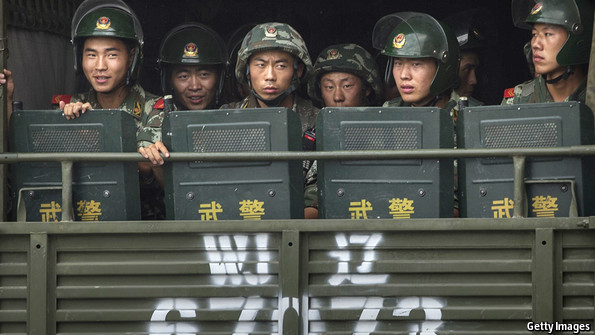
A Chechnya in the making

China’s far west

An iron fist in Xinjiang is fuelling an insurrection. China’s leadership must switch tactics | | From the print edition

The Uighurs have never been particularly comfortable in China. Xinjiang, the region where these Turkic Muslims once formed the vast majority, came unwillingly into the Chinese empire. Rebels in parts of it even set up independent republics; a short-lived one was snuffed out by the Communist Party in 1949. Since then the regime in Beijing, 1,000 miles (1,600km) to the east, has sought to keep Xinjiang quiet. The policy is not working. The presidency of Xi Jinping risks sinking into a quagmire of ethnic strife. This could be China’s Chechnya.

China’s Response to the MH17 Tragedy? Condemn the West

July 21, 2014

Experts inspect the wreckage of Malaysia Airlines plane
Search and rescue specialists inspect the crash area of Malaysia Airlines flight 17, carrying nearly 300 people from Amsterdam to Kuala Lumpur when it was downed close to Russia's border with Ukraine on July 17, near Grabovo. Anadolu Agency—Getty Images

Despite memories of decades of Cold War frostiness, Beijing is now quite chummy with Moscow

On July 18, shortly after Malaysia Airlines Flight 17 crashed over eastern Ukraine, extinguishing 298 lives, China’s Xinhua state news agency cautioned against making snap judgments. The U.S. and other Western nations had begun to finger pro-Russian rebels in Ukraine for shooting down the Boeing 777 passenger plane, but Xinhua dismissed such accusations as “rash” and took the opportunity to swipe at Western democracies for their condemnation of Russia’s earlier military intervention in Ukraine:
The one-sided accusation is not surprising in light of their long-time stance on the crisis in eastern Ukraine, and their attitude towards Russia’s absorption of Crimea in March. But without convincing evidence, jumping to a conclusion will only heighten regional tension and is not conducive to finding out the truth.
Russian President Vladimir Putin late Thursday said it is Ukraine that bears the responsibility as the tragedy occurred over its territory. The tragedy, Putin said, could have been avoided should Ukraine’s eastern regions be in peace.
On July 21, the People’s Daily, the Chinese Communist Party’s mouthpiece, ran a piece still cautioning that “no proof has been found so far to clarify the cause or identify the perpetrator.” Nowhere did the story mention the likelihood that pro-Russian rebels had trained a missile on MH17 as it flew from Amsterdam to Kuala Lumpur.
The same day, the Global Times, a Chinese Communist Party-linked daily that can be counted on for nationalist commentary, did at least mention such a possibility — if only to decry Western governments’ speculation that Russia may have aided and abetted the rebels’ cause:
The Western rush to judge Russia is not based on evidence or logic. Russia had no motive to bring down MH17; doing so would only narrow its political and moral space to operate in the Ukrainian crisis. The tragedy has no political benefit for Ukrainian rebel forces, either. Russia has been back-footed, forced into a passive stance by Western reaction. It is yet another example of the power of Western opinion as a political tool.
The crisis in Ukraine had already put China in a difficult position. Despite memories of decades of Cold War frostiness, Beijing has boosted its ties with Moscow. The two neighbors share an antipathy toward Western democratic values and a mutual interest in natural resources. The first foreign trip Xi Jinping made as President was to Russia in March 2013.
Yet China also proclaims that one of its foreign-policy bedrocks is staying out of other nations’ internal affairs. Russia’s invasion of Crimea — which Xinhua delicately termed an “absorption” — cannot be considered as anything but a gross interference in Ukraine’s internal affairs. Beijing is struggling with separatist sentiment at home, most notably among Tibetan and Uighur populations in China’s far west. How can Chinese foreign-policy makers support an ethnic rebel movement over a national government, even if those separatists do have Russia’s tacit blessing?
China may soon have to reconcile this foreign-policy quandary. “It will bring about a severe challenge to China’s general strategy and diplomacy if America and Europe propose sanctions against Russia and demand China should join with them,” wrote Chinese security analyst Gao Feng in a widely disseminated blog post. “For China, the issue is which side it should choose. Without doubt, an ambiguous stance [by Beijing] will face criticism and moral pressure.”
There were no mainland Chinese nationals on MH17. By contrast, Malaysia Airlines Flight 370, which vanished in March en route from Kuala Lumpur to Beijing, was filled with Chinese passengers. As the Malaysian investigation into that plane’s disappearance foundered, Chinese authorities allowed MH370 families to stage protests in Beijing — a rarity in a nation allergic to public displays of dissent.
This time around, official Chinese sentiment has steered clear of blaming Malaysia for the Ukraine disaster. Instead, West-bashing has predominated. “The West has successfully put itself in a position to dictate ‘political correctness’ in international discourse,” said the Global Times editorial on MH17 on Monday. “Those unwilling to work with Western interests will often find themselves in a tough position.” Criticism of the West even extended beyond the tragedy of MH17. On July 21, Xinhua publicized a new campaign of “intense ideological education for officials to strengthen their faith in communism and curb corruption.” First on cadres’ to-do lists? Keeping a “firm belief in Marxism to avoid being lost in the clamor for western democracy.”
— With reporting by Gu Yongqiang / Beijing

Sep 8, 2013

Putin: lonely, scared and confused

Talk to real master of situation, not his shadow


Before the G-20 Summit Putin assured the world in the official interview  that he has not ruled out backing a U.S.-led military operation in Syria if the Kremlin gets concrete proof than an alleged chemical attack on civilians was committed by Bashar Assad’s regime. The sincerity of Putin’s intention was obvious – he bases all his prestige on the Soviet Victory in the WWII over atrocious regime of Hitler, but now he finds himself and Russia on the side of the “Syrian Hitler”, using gas against his own people.  Putin understands that despite his huge propaganda efforts, he will not be able to manipulate the public opinion for long. It seems suddenly he started to realize that this time he risks remaining on the wrong side of history.
For the West the Kremlins condition is quite easy to satisfy, as there are enough proofs that only the Assad forces could conduct the chemical attack.  Next day – one day before the Summit - Putin unexpectedly produced a U-turn, publicly called John Kerry a “liar” using an obvious manipulation.  Putin’s sudden change of heart is the main intrigue of the G-20 Summit and deserves some attention.
Failed Mega Deal
What happened in between? Day before the Summit Putin had a pompous meeting with the Chinese leader where Russia expected to sign a mega-deal for gas supply to China.  Then top Chinese official stated that any military actions in Middle East would lead to the oil prices growth and because of this the China opposes to the strike.  However, much advertised  “mega-deal”, expected by Russia, has failed as Chinese continue to insist on a half-price of the usual price Russia gets in Europe.
Moreover, a couple days earlier China signed a mega-deal with gas rich Turkmenistan, more than doubling the gas exports to China. Day after the Summit China struck a $30 billion deal with Kazakhstan including purchase of the $5 billion stake in the giant Kashagan oilfield.  
Therefore, China is not in hurry and can quietly wait, when Russia get totally isolated by the West and be ready for a slow and quiet technical takeover by China. China doesn’t want to invest in Russia, but agrees to finance some big industrial project as the Far East with a precondition that this enterprises will be in its ownership and workers will be only from China. As Russian economy is sinking despite the high oil and gas prices Putin a bit earlier or later will have to accept the Chinese proposition. This would mean a “forever concession” by China of the Russia’s Far East.
Russia’s Political Bluffing
This makes Russia extremely nervous and dependent on China. It gradually increases its influence in the region, which Russia considers its “legitimate sphere of interests” and leaves Russia out in the cold.  However, Russia does not dare to complain.  Instead, it pretends having a very special relation and a strong alliance with China as opposing to the failing relation with the West. 
China calls Russia a “major country” and lets it fight its revisionist fights with the West, but does not view Russia as an equal partner.  On the Chinese President visit’s  web page  there are mostly  pictures of  Chinese President with American President Obama, but there is no any picture with Russian President Putin.  This shows where the real China’s priorities are.  
Putin’s dependence on China explains Putin’s U-turn.  Trying hard to please Chinese President, he found not exactly elegant way to reverse his recent declaration on possible joining the international effort against Bashar Assad by calling John Kerry a “liar” and returned to his usual slogans about Syria.
Upgrading Role for China
Putin’s miserable position, which he masks with the massive PR efforts, promoting his image and ideas at the West, makes him useless as a negotiator on Syria.  The real master of the situation is China. If the leader of this country really thinks that the oil price growth is the only objection to the common action in Syria the negotiations should be conducted with him, not with the politically impotent Putin.  In this case, Chinese and the Western position on Syria coincide. Russia on the contrary is objectively interested in maintaining the civil war in Syria as a precondition for a high oil price, on which Russian economy depends.
The U.S. should convince China that the sooner the situation in Syria is resolved the sooner the oil prices would go down.  This could become a first international action, where China can show its political maturity and responsibility for the World. China could like this  as it is follows already the U.S. example offering assistance to the different countries. Cash rich China can show a real leadership helping freed from the Assad’s regime Syria after the conflict is over.

Jun 29, 2013

U.K. Finds Its Beppe Grillo - Bloomberg

U.K. Finds Its Beppe Grillo - Bloomberg

By Marc Champion Mar 1, 2013 2:19 PM GMT+0200

U.K. Prime Minister David Cameron's tactic of pledging to claw back powers from the European Union and then hold a referendum on whether to leave or stay in the bloc has failed its first election test.

That was the general consensus in the U.K. news media this morning, after Cameron's Conservative Party was reduced to a humiliating third place in a by-election in the southern constituency of Eastleigh. The Tories were beaten not only by their coalition partners, the Liberal Democrats (who held on to the seat), but also by the UK Independence Party.

The EU referendum pledge that Cameron made in January was designed precisely to stanch the flow of right-wing Conservatives to the UKIP. This week, it failed. Already this morning, conservative commentators in newspapers such as the Daily Telegraph were saying the result proved that Cameron should hold a referendum on whether to stay in the EU immediately, rather than by 2017; crack down harder on immigration; and abandon recent policies such as legalizing gay marriage.

Jun 24, 2013

The G8 should push for a ceasefire in Syria, Pope tells David Cameron | CatholicHerald.co.uk

The G8 should push for a ceasefire in Syria, Pope tells David Cameron | CatholicHerald.co.uk
David Cameron arrives in Belfast ahead of the G8 summit (PA)

David Cameron arrives in Belfast ahead of the G8 summit (PA)

The G8 nations meeting in Northern Ireland this week should push for “an immediate and lasting ceasefire” in Syria, Pope Francis has said in a letter to the British Prime Minister.

Responding to an earlier letter from David Cameron, Pope Francis wrote: “I earnestly hope that the summit will help to obtain an immediate and lasting ceasefire and to bring all parties in the conflict to the negotiating table. Peace demands a far-sighted renunciation of certain claims, in order to build together a more equitable and just peace. Moreover, peace is an essential pre-requisite for the protection of women, children and other innocent victims, and for making a start towards conquering hunger, especially among the victims of war.”

In his letter the Pope noted that the summit, which takes place today and tomorrow at Lough Erne in County Fermanagh, would focus on the British Government’s priorities of “the free and international market, taxation, and transparency on the part of the governments and economic actors”.

But he said that “fundamental reference to man is by no means lacking” in the summit agenda.

“The goal of economics and politics is to serve humanity, beginning with the poorest and most vulnerable wherever they may be, even in their mothers’ wombs,” he said. “This is the main thing; in the absence of such a vision, all economic activity is meaningless.”

Full text of Pope Francis’s letter to David Cameron, dated June 15:

To The Right Honourable David Cameron, MP Prime Minister,

I am pleased to reply to your kind letter of 5 June 2013, with which you were good enough to inform me of your Government’s agenda for the British G8 Presidency during the year 2013 and of the forthcoming Summit, due to take place at Lough Erne on 17 and 18 June 2013, entitled A G8 meeting that goes back to first principles.

If this topic is to attain its broadest and deepest resonance, it is necessary to ensure that all political and economic activity, whether national or international, makes reference to man. Indeed, such activity must, on the one hand, enable the maximum expression of freedom and creativity, both individual and collective, while on the other hand it must promote and guarantee their responsible exercise in solidarity, with particular attention to the poorest.

The priorities that the British Presidency has set out for the Lough Erne Summit are concerned above all with the free international market, taxation, and transparency on the part of governments and economic actors. Yet the fundamental reference to man is by no means lacking, specifically in the proposal for concerted action by the Group to eliminate definitively the scourge of hunger and to ensure food security. Similarly, a further sign of attention to the human person is the inclusion as one of the central themes on the agenda of the protection of women and children from sexual violence in conflict situations, even though it must be remembered that the indispensable context for the development of all the afore-mentioned political actions is that of international peace.

Sadly, concern over serious international crises is a recurring theme in the deliberations of the G8, and this year it cannot fail to address the situation in the Middle East, especially in Syria. In this regard, I earnestly hope that the Summit will help to obtain an immediate and lasting ceasefire and to bring all parties in the conflict to the negotiating table. Peace demands a far-sighted renunciation of certain claims, in order to build together a more equitable and just peace. Moreover, peace is an essential pre-requisite for the protection of women, children and other innocent victims, and for making a start towards conquering hunger, especially among the victims of war.

The actions included on the agenda of the British G8 Presidency, which point towards law as the golden thread of development – as well as the consequent commitments to deal with tax avoidance and to ensure transparency and responsibility on the part of governments – are measures that indicate the deep ethical roots of these problems, since, as my predecessor Benedict XVI made clear, the present global crisis shows that ethics is not something external to the economy, but is an integral and unavoidable element of economic thought and action. The long-term measures that are designed to ensure an adequate legal framework for all economic actions, as well as the associated urgent measures to resolve the global economic crisis, must be guided by the ethics of truth. This includes, first and foremost, respect for the truth of man, who is not simply an additional economic factor, or a disposable good, but is equipped with a nature and a dignity that cannot be reduced to simple economic calculus. Therefore concern for the fundamental material and spiritual welfare of every human person is the starting-point for every political and economic solution and the ultimate measure of its effectiveness and its ethical validity.

Moreover, the goal of economics and politics is to serve humanity, beginning with the poorest and most vulnerable wherever they may be, even in their mothers’ wombs. Every economic and political theory or action must set about providing each inhabitant of the planet with the minimum wherewithal to live in dignity and freedom, with the possibility of supporting a family, educating children, praising God and developing one’s own human potential. This is the main thing; in the absence of such a vision, all economic activity is meaningless.In this sense, the various grave economic and political challenges facing today’s world require a courageous change of attitude that will restore to the end (the human person) and to the means (economics and politics) their proper place. Money and other political and economic means must serve, not rule, bearing in mind that, in a seemingly paradoxical way, free and disinterested solidarity is the key to the smooth functioning of the global economy.

I wished to share these thoughts with you, Prime Minister,, with a view to highlighting what is implicit in all political choices, but can sometimes be forgotten: the primary importance of putting humanity, every single man and woman, at the centre of all political and economic activity, both nationally and internationally, because man is the truest and deepest resource for politics and economics, as well as their ultimate end.Dear Prime Minister, trusting that these thoughts have made a helpful spiritual contribution to your deliberations, I express my sincere hope for a fruitful outcome to your work and I invoke abundant blessings upon the Lough Erne Summit and upon all the participants, as well as upon the activities of the British G8 Presidency during the year 2013, and I take this opportunity to reiterate my good wishes and to express my sentiments of esteem.

Full text of David Cameron’s letter to Pope Francis, dated June 5:

Your Holiness,

When I said farewell to Pope Benedict at the end of his historic State Visit to Britain in September 2010, I made a number of promises. I said that the United Kingdom would keep its promises on aid, in particular in dedicating 0.7% of GNI to international development aid, despite the tough economic times. I said that we would continue to help the poorest and ensure the money we spend on aid goes to those who need it most. I also promised that we would redouble our resolve to work for the common good, working closely with the Holy See.In 2013, the United Kingdom holds the Presidency of the G8 group of nations.

I am determined to ensure that our G8 agenda will lead to real benefits for the global economy and will help people in developed and developing countries alike. Your Holiness has spoken eloquently about the need to rebalance the global economy, to help the poor and disadvantaged, and to find people work. My aim for our G8 Presidency, especially at the G8 Summit at Lough Erne on 17 and 18 June, is to do this by restoring strong and sustainable growth to the world economy by practical action on fairer taxes, freer trade, and greater transparency.

I will use the G8 to galvanise collective international action to effectively tackle tax evasion and aggressive tax avoidance – problems shared by developed and developing countries alike. We shall promote a new global standard for automatic information exchange between tax authorities to shrink the space for tax evasion. We shall provide political support for the ongoing OECD and G20 work to prevent some individuals and corporates artificially shifting their profits to ultra-low tax jurisdictions, distorting competition and seek to enhance the flow of information to tax authorities. We shall seek to set out concrete steps we will take to let law enforcement and tax collectors find out who really owns and controls every company. We shall also explore what more can be done by the G8 to support lower-income developing countries to collect the tax revenues owed to them, thereby strengthening their public services in areas like health and education on which people’s well-being depends.

On trade, I know the Vatican has taken a keen interest in trade liberalisation, particularly the potential that it offers to alleviate poverty, and the need to ensure the poorest countries are integrated into the global economy. This is very much in line with the trade agenda for Lough Eme. We shall ensure that the G8 shows leadership on free trade by opening our markets, resisting protectionism and supporting an open, global rule-based trading system to ensure that all countries can benefit from increased trade. Protectionism and trade bureaucracy are amongst the most significant brakes on the global economy, affecting developing and developed economies alike and creating a barrier to economic and social progress. This is why I will put political impetus on progressing bilateral and plurilateral deals as well as supporting the multilateral trading system.

We will support efforts to conclude a multilateral deal on Trade Facilitation at the WTO Ministerial Conference in December, which could add $70 billion to the global economy and would help boost trade in Africa in particular. We will also work with African countries to help them realise their goal of a Continental Free Trade Area, including through our support for regional integration. This could see intra-African trade double by 2022. If G8 countries complete all of their current trade deals and those in the pipeline, it could boost the income of the whole world by more than $1 trillion.

Under our G8 Presidency, I also want to see real progress on tackling food and nutrition insecurity through practical action and greater political commitment to fighting global malnutrition.Many of the world’s poorest countries are shackled by a lack of transparency, poor mles, corrupt practices and weak capacity. Too often, a veil of secrecy allows corrupt corporations and officials in countries to flout the law and prevent development. Too often, mineral wealth in developing countries becomes a curse rather than a blessing, as a lack of transparency fosters crime and corruption. Too often, instead of a shared hope for the next generation, such wealth brings conflict, greed, and environmental damage. Through the G8, I plan to push for mandatory higher global standards for the extractives sector, to encourage responsible and sustainable investment in land, and setting the standards for ensuring that government data are released in an open and useable format.

Finally, the High Level Panel Report on the post-2015 development agenda, which we transferred to the UN Secretary General last week, highlighted the importance of trade, tax and transparency to better the lives of the world’s poorest. The Report presents an ambitious roadmap to eradicate extreme poverty from the face of the earth by 2030. It says that everyone – regardless of gender, ethnicity, income, disability, age – must have their basic needs met, and their economic and human rights respected. It too makes a strong call for economic growth that promotes social inclusion and preserves the planet’s natural resources for future generations. It says that freedom from violence, good governance and justice are not only fundamental to achieving poverty eradication, but goods in themselves that all citizens of the world have equal right to enjoy. I hope that you will be able to read the Report and offer support for its core messages.You have called for disinterested solidarity and for a return to person-centred ethics in the world of finance and economics. As President of the G8, I aim to help secure the growth and stability on which the prosperity and welfare of the whole world depends. To do this, we must tackle the conditions that cause poverty, stiffen the sinews of responsible capitalism, and strengthen governance and transparency.

I believe that this path is one which requires more than the G8 to find success, that responsible governments, business and faiths can and should travel together, doing what we can to turn these values into practical action for the benefit of all.

Apr 23, 2013

Boston Bombing Suspects' uncle tells of familial break

Boston Bombing Suspects' uncle tells of familial break - YouTube

After Boston and Tsarnaevs, Russians Urge U.S. to Rethink Chechnya - NYTimes.com

Pedestrians cross Putin Prospect, one of the main streets in the Chechen capital Grozny on April 20.
Reuters Pedestrians cross Putin Prospect, one of the main streets in the 
Chechen capital Grozny on April 20.
After Boston and Tsarnaevs, Russians Urge U.S. to Rethink Chechnya - NYTimes.com
LONDON — Russian commentators are speculating that a Chechen connection in the Boston Marathon bombings will force the United States to reassess its view of the Kremlin’s actions in the troubled Caucasus region.
After the capture on Friday night of Dzhokhar A. Tsarnaev, the second suspect in Monday’s attack, following the death of Tamerlan Tsarnaev, his brother, in a gun battle with police, U.S. authorities have yet to establish a motive for the crime.
In Russia, as in the United States, attention focused on whether the bombings were connected with the politics of Chechnya, where the brothers’ family originated.
Reuters Pedestrians cross Putin Prospect, one of the main streets in the Chechen capital Grozny on April 20.
The possibility of such a connection being established is already raising questions about what it means for the recently strained relationship between Moscow and Washington.

Brother’s Keeper: Did Older Sibling Lure Bombing Suspect Into Plot? | TIME.com

Brother’s Keeper: Did Older Sibling Lure Bombing Suspect Into Plot? | TIME.com

Brother’s Keeper: Did Older Sibling Lure Bombing Suspect Into Plot?


The dramatic arrest of Boston Marathon bombing suspect Dzhokhar Tsarnaev on Friday night brought the entire city of Boston a collective sense of relief, with crowds streaming into the streets to chants of USA. But the end of the manhunt was in many ways just the start of the process for investigators trying to piece together what may have motivated Tsarnaev, 19, and his older brother Tamerlan, 26, who was killed by police early Friday morning. And details emerging over the first 24 hours since police captured the younger Tsarnaev in a backyard boat in Watertown, Mass., reinforce the growing perception that his older brother was the primary driver of the attack.

Mar 10, 2013

Beppe Grillo leads yet another right-wing cult from Ita

Austerity and its discontents

A group blog On Europe edited by Daniel Trilling
Syndicate contentRSS

Essay: beneath its populist surface, the Five Star Movement represents more of the same.


Beppe Grillo, at a pre-election rally in Rome on 22 February. (Photo: Getty.)
Marriage is a bond between a man and a woman. How can you institute marriage between two persons of the same sex? Why not marriage between three persons then? Why not marriage between you and your animal? Some people have a strong relationship with their animal, would you allow them to marry it?
(Francesco Perra, 5 Star Movement candidate at the recent national election, 8 June 2012 )
There is much confusion in other countries about what has been taking place in Italy in the past five years – the era of Late Berlusconism – and what is going on after the latest national election. At the time of writing, nobody knows what government Italy will have. No stable government can be formed without the vote of confidence of the Five Star Movement, the political organisation led by former stand-up comedian Beppe Grillo and web marketing guru Gianroberto Casaleggio. The Five Star Movement (5SM), which stood for national election for the first time, gained 25.5 per cent of votes for the Chamber of Deputies and 23.8 per cent for the Senate.

Nov 25, 2012

LUKOIL opens new terminal at Barcelona port

LUKOIL opens new terminal at Barcelona port // Companies // News | Neftegaz.RU
02 May 2012 , 10:31Neftegaz.RU672
Vagit Alekperov, President of OAO LUKOIL, and Jose Luis Porté, President of Meroil, participated in the festive ceremony today dedicated to the commissioning of a new petroleum terminal at the port of Barcelona (Spain).

The project was implemented by a joint venture (50/50) established in July, 2010 between LITASCO, an international oil trader (a wholly-owned subsidiary of LUKOIL), and the Spanish company Meroil.
The new terminal was constructed as part of a project to expand Meroil’s existing terminal capacities.


Thirteen new tanks with an aggregate storage capacity of 360,000 cubic meters, and ranging in volume from 6,500 to 40,000 cubic meters, were constructed within an area of 40,000 square meters. The new terminal, connected to the pipeline system of Hydrocarbonates Logistics Company, includes 8 petroleum-product loading gantries with at hroughput capacity of 400 tank trucks per day.

Sep 10, 2012

From the European ‘Party of Discontents’ to the Authoritarian ‘Axis of Resistance' to the West?

By Irina Severin | 20.08.12

Will Merkel's Visit to Moldova Make a Difference?


Why Angela Merkel, the most influential European politician, in the midst of the EU financial crisis decided to visit Moldova - Europe's poorest and otherwise insignificant country? Why bother?

A glance at the map shows that Moldova including its breakaway region Transnistria (self-proclaimed in 1990-s with the Russian Army support) is sandwiched between two countries, problematic for the EU:  Ukraine with the "Tymoshenko case" and Romania with the 'Basescu case'. Both countries Romania as a member of the EU and Ukraine,   proclaiming the European aspirations demonstrate clear potential for sliding into authoritarianism. 

In both cases, there are indications of Russian involvement in domestic political processes. In the Romanian case, Russia was traced as encouraging the Ponta-Antonescu 'coup' against Basescu. In Ukraine, Russia's growing meddling limits Ukrainian potential for democratization.

The economic pressure is another instrument of influence. In both cases,  gas prices being political are used for control of the political and economic situation in the countries.

Transnistria, existing mostly for justification of the Russian military presence in the region, is a direct threat to security in the Europe, not a "stabilizing factor" as Russia pretends.  Russia involvement wouldn't be a threat if Moscow were moving to rapprochement with the EU modernizing its political and economic system. Germany is interested in cooperation with Russia, but both the EU and Germany need to see that Russia is open for the European values as a precondition for closer interaction and for being guaranty for stability.
In 2009 Angela Merkel offered closer cooperation to Medvedev in exchange to Russia constructive role in the Transnistrian frozen conflict settlement. Russia didn't advance in this direction preferring to impose its will maintaining its military presence on the border with the EU. Russia is quite pessimistic about the EU future considering it a temporary experiment and recalling that about 50 years ago European countries were each other’s worst enemy.
Moscow thinks that the EU dissolution would rise Russia to a great power status. Though, Russia's plans are much more ambitious. Russia considers its  Eurasian Union an alternative to the EU and doesn't limit it with the former USSR borders as some used to think. 

As Fyodor Lukyanov mentions in his article Uncertain World: Does Europe Have Any Alternative? Moscow doesn't exclude that it can relapse in what it names 'big Balkan game’ and even ‘big Orthodox game’ (including Greece and Serbia, for instance)."
From the European 'Party of Discontents'…
Meantime Russia tries to get control over the EU's decision-making without abiding by the European principles, but converting the EU countries to its own political 'matrix'. Technically this is achievable by encouraging the EU countries' politicians to break the EU political standards and oppose to the EU requirements. 

Now this is happening in Romania with Ponta government.  He came to power by organizing protests against President Basescu accusing him in complying with the tight the EU and IMF requirements.  Ponta's actions are tempered for now by coming parliamentary elections. Romanians are staunchly pro-European, and any anti-European rhetoric would obstruct their chances to win elections. 

Earlier Greek Syriza incited long-term protests against the EU and IMF, what put on the brink of collapse not only Greece but the EU and Eurozone as well. 

Opposing to the EU and the IMF from left or right by default puts any country into the Russian sphere of influence and at Russia's mercy.  Lukyanov names this opposition to the EU "the growing "party of discontents": "Both ideological extremes are brought together by the new rhetoric calling on the government to defend the public against the social ills of globalization". Further, he explains:
The difference between the ‘party of recovery’(consisting of Conservatives, Christian Democrats, Liberals and Social Democrats) versus the 'party of discontents' lies in their ability to run the state. The former has a clear idea of what should be done and how, but finds it increasingly difficult to garner public support, while its opponent can channel public sentiment but lacks a strategy of its own. The discontents are chanting slogans without assuming any responsibility. 
Ideological developments are more complicated. One EU country, Hungary, is already essentially turning its back on European values. It is increasingly leaning towards a more conservative and nationalist policy. 
On another side of Moldova - in Ukraine Russia recently managed to considerably advance its interests in exchange for a promise of lower gas prices. The "Language law" offers status of the regional language to the Russian language making the Ukrainian language redundant in more than half of Ukraine. 

Now Russian propagandists promote as the next step the idea of partition of Ukraine on the Ukrainian-speaking West and predominantly Russian-speaking rest of the country, where the Ukrainian language will be excluded, and the Ukrainian speakers will become the unprotected minority. 


The "Language law" has radicalized and polarized political situation in Ukraine,  making the country unstable before the elections. Not to mention here the incarceration of the opposition leaders, what is the anathema for the EU, but an apparent gain for Russia.
On this background,  Moldova despite all odds following democratic principles and adopting European values is looking like a rare case of success, which can become a showcase for others. The country doesn't require massive investments and is genuinely European. 
At the same time, lack of 'clear European prospective' for Moldova makes it a subject of the Russian pressure. One of the instruments is artificially created fringe movements: pro-Russian, invoking reunification with Russia and 'anti-Russian', promoting reunification with Romania. 

Both extremes exploit and boost nationalistic moods and raise the grade of polarization of the society. Recent March, organized by a fringe group supporting Unification with Romania, led to staged clashes with the "Patriots of Moldova", another fringe group, promoting the idea of unification with Russia. Naturally, such performances don't encourage the Transnistrian conflict resolution. Quite the opposite - they offer a justification for the existence of Russia's  military outpost on the Dniester. 
…To the Authoritarian 'Axis of Resistance' to the West
Merkel's encouragement of Moldova's European aspirations can strengthen Moldova as a stability factor in the region as well as a positive example for the neighboring countries. Otherwise, Moldova as small as it is can trigger a massive destabilization,  which can reach as far as the Balkans and Greece. Moldova’s territorial integrity and sovereignty is a key for the European security and stability.
If not supported now Moldova together with the EU's "party of discontents" one day can become a part of the authoritarian 'Axis of resistance' to the West, which Putin is working hard to create after his return to the presidency. 

The Authoritarian Axis became apparent due to the Syria case. Apparently, it includes Russia, Syria, China, Iran, North Korea, Venezuela. The situation starts to resemble the "Cold War" bi-polar world order when two sides were fighting for promoting their political models to expand their influence. 

Putin managed to replace the communism with the ideology of the Resistance to the West but has nothing to offer as an alternative political or economic model. Exactly as the European  "party of discontent", ‘ "detected"  by Lukyanov,  Moscow knows how to "channel public sentiment" and "to sow the seeds of discontent’ around the world, but doesn't know what to do next. Being underdeveloped and ineffective Russia could only lead the world to the chaos. 
For many years the reply of the West to Russia's growing assertion abroad was 'we don't fight with Russia'. But the problem is that Russia is fighting the West. And the West should at least acknowledge this. And if not fighting back at least to secure democratic values and principles in the world with some meaningful steps. Supporting Moldova today Merkel invests in stability and security in the Europe, what can be not achievable tomorrow.
The next day after Angela Merkel's announcement about her coming to Moldova Prime Minister Vlad Filat has got an invitation from  Moscow to meet Vladimir Putin after Merkel's visit. Will Moldova become the next target of promises of lower gas prices in exchange for the anti-Western  'discontent moves'?

Jun 15, 2012

Is Ron Paul A Useful Idiot?

Is Ron Paul A Useful Idiot?
Big Peace ^

Posted on Sunday, August 28, 2011 07:38:01 AM by mnehring
You saw it here first, folks!
Clueless?
Over at the American Spectator, the great Jeffrey Lord writes that “almost to a person … prominent pre-Ron Paul non-interventionist “Paulist” politicians of the 20th century were overwhelmingly not conservatives at all. They were men of the left. The far left.”
From three-time Democratic presidential nominee and Woodrow Wilson Secretary of State William Jennings Bryan to powerful Montana Democratic Senator Burton K. Wheeler to FDR’s ex-vice presidential nominee Henry Wallace to the 1968 anti-war presidential candidacy of Minnesota Democratic Senator Eugene McCarthy to 1972 Democratic presidential nominee (and Henry Wallace delegate in 1948) George McGovern, non-interventionists have held prominent positions in the American Left that was and is the Democratic Party.(emphasis added)

What was unique about Wallace’s 1948 Progressive Party campaign was how it was completely controlled by the secret Communist Party agents that surrounded Wallace, despite the fact that he was not a Communist. Lillian Hellman, who despite her denials was indeed a secret member of the Communist Party, admitted as much in her 1976 book Scoundrel Time:
During the early autumn of 1948, four or five of us [leaders of the Progressive Party campaign] were eating lunch together on the day of a large evening rally. When lunch was finished Wallace suggested that he and I take a walk. … When we had walked for a while, he asked me if it was true that many of the people, the important people, in the Progressive Party were Communists. It was such a surprising question that I laughed and said most certainly it was true.
He said, “Then it is true, what they’re saying?”
“Yes,” I said. “I thought you must have known that. The hard, dirty work in the office is done by them and a good deal of the bad advice you’re getting is given by the higher-ups. I don’t think they mean any harm; they’re stubborn men.”
“I see,” he said, and that was that.
What is clear is that the Communists – who, of course, did mean harm – were able to drive the campaign of a non-Communist due to their influence. And Wallace knew it, despite his public denials. As Arthur Herman pointed out in National Review “when Hubert Humphrey complained about the prominent role Communists were playing in the election, Wallace blithely told him to go talk to the Russian embassy — it had more influence over his campaign officials than he did.”

So if it can happen to Henry Wallace, why can’t it happen to his Republican mirror, Ron Paul? On Thursday, Mark Levin had Jeffrey Lord on his show to talk about his article (listen to it here, here and here), where they discussed all the crackpots and “neo-confederates” that surround Ron Paul in his inner circle. What would a group like think of, say, Israel?

Well, on his own website, we find that: “On January 9, [2009] Ron Paul addressed Congress to voice his opposition to a House resolution expressing strong support for Israel in its invasion of Gaza, and branding Hamas as a terrorist organization.” It goes on to proudly highlight that he went on Press TV (the Iranian state propaganda channel) and Russia Today (KGB-TV basically, with it’s paid agents promoting and even doing fund-raising for Ron Paul).
Anyone who has spent time around his supporters know what they think of Israel, and likely had to hear the anti-Semitic conspiracy theories that are so widespread in his little cult. What is their influence? Why doesn’t he denounce them? Also, such a denunciation would have a devastating impact both the national and international crackpot communities that sustain anti-Americanism, as the great Cold War era defector and former KGB General turned American Patriot Ion Mihai Pacepa explained. Wouldn’t that be in our national interest, Dr. Paul?

Jun 8, 2012

Russia eXaminer: Russia and China - Partnership of "Rabbit and Boa"

Russia eXaminer

Russia-China Anti-Western Friendship Leads to Global Chaos and Russia Takeover

By Irina Severin | 07.06.2012
Putin's three-day visit to China after his demonstrative refusal to participate in the Summit of the developed countries in the United States says that he does have something to discuss with the Chinese leadership. Moreover this is an opportunity to demonstrate to the West that Putin has an alternative. There is no doubt that he feels more comfortable there where nobody recalls of human rights and democracy, what Putin calls unnecessary "ideologization" in relations with the West.